
Export Facilitation Services in Bangladesh
Md. Joynal Abdin
Founder & Chief Executive Officer, Trade & Investment Bangladesh (T&IB)
Editor, T&IB Business Directory; Executive Director, Online Training Academy (OTA)
Secretary General, Brazil Bangladesh Chamber of Commerce & Industry (BBCCI)
Bangladesh has steadily emerged as one of the most promising export-oriented economies in Asia. Over the last few decades, the country has transformed from a largely aid-dependent economy into a major global manufacturing and sourcing destination. Today, Bangladesh is widely known for its ready-made garments sector, but its export potential extends far beyond apparel. The country is also developing strong capabilities in textiles, leather goods, jute products, agro-processed items, pharmaceuticals, frozen foods, ceramics, light engineering products, ICT services, and other value-added industries. This growing diversification has created significant opportunities for local manufacturers, foreign buyers, sourcing agents, and aspiring exporters.
The export sector plays a central role in Bangladesh’s economic development. It generates foreign exchange, supports industrial employment, drives investment in production facilities, and connects local enterprises with regional and international markets. For thousands of businesses across Bangladesh, exporting is no longer a distant ambition. It is becoming an essential growth strategy. However, export success does not happen automatically. Producing a good product is only one part of the journey. Exporters must also understand foreign market demand, comply with import regulations, prepare documentation accurately, meet international standards, arrange shipping, manage payments, and build trust with overseas buyers.
This is where export facilitation services in Bangladesh become highly important. These services help businesses move from local production to international trade in a more organized, compliant, and profitable way. They reduce confusion, lower transaction risk, shorten the learning curve, and improve the chances of sustained export growth. For first-time exporters, they provide the structure and guidance needed to enter global markets. For experienced exporters, they improve efficiency, strengthen compliance, and support expansion into new countries and product categories. For foreign companies that want to source from Bangladesh, export facilitation services help identify suitable suppliers, navigate procedures, and establish reliable trade relationships.
As global trade becomes more competitive and compliance-driven, export facilitation is no longer just a supportive function. It is a strategic necessity. Businesses that use the right export support services are generally better positioned to secure orders, fulfill requirements, manage risks, and scale internationally. In Bangladesh, where many SMEs, manufacturers, and entrepreneurs have exportable products but limited trade expertise, these services can make the difference between unrealized potential and real export success.
This article provides an in-depth overview of export facilitation services in Bangladesh, explains what they mean, describes the top ten services in detail, and highlights how Trade & Investment Bangladesh (T&IB) can support local and foreign exporters through professional export support solutions.
What Are Export Facilitation Services?
Export facilitation services are the range of professional, technical, advisory, operational, and promotional services that help businesses export products or services from one country to another. In the context of Bangladesh, these services help local firms access foreign markets and help international buyers or importers connect more effectively with Bangladeshi suppliers.
In practical terms, export facilitation services support businesses throughout the full export cycle. They begin with export readiness assessment and market selection, continue through compliance guidance, documentation support, pricing, logistics, and buyer search, and extend into trade promotion, digital marketing, post-shipment coordination, and long-term international business development. These services may be delivered by trade consultants, export houses, chambers of commerce, business associations, logistics providers, customs specialists, marketing agencies, sourcing consultants, or trade facilitation platforms.
For new exporters, export facilitation services help answer key questions. Which markets are best? What product modifications are needed? Which certificates are required? How should export prices be calculated? Which documents are necessary? How can foreign buyers be found? Which payment terms are safest? Without professional support, many businesses struggle with these questions and either delay their export plans or make costly mistakes. Export facilitation services help solve these problems systematically.
For established exporters, the value is equally important. They may need to diversify into new markets, strengthen their branding, comply with updated standards, participate in trade fairs, optimize shipping arrangements, or identify new product opportunities. Export facilitation helps improve operational performance and supports strategic growth.
From a broader perspective, export facilitation services contribute to national trade competitiveness. They help SMEs internationalize, improve export quality, strengthen market linkage, and make the overall trade ecosystem more efficient. In Bangladesh, where many businesses have strong production capability but limited international exposure, these services act as a bridge between domestic capacity and global opportunity.
Why Export Facilitation Services Matter in Bangladesh?
Bangladesh offers significant export opportunities, but the path to export success can be complex. A business may have a quality product and competitive production costs, yet still fail to export effectively because of weak market knowledge, insufficient compliance, poor packaging, or limited access to buyers. Export facilitation services matter because they help solve these exact problems.
One major reason they are important is that international trade involves multiple layers of requirements. Exporters must deal with customs regulations, payment instruments, commercial contracts, product standards, shipping schedules, labeling rules, tariff structures, and buyer expectations. For many Bangladeshi SMEs, these areas are unfamiliar. Professional support reduces uncertainty and helps businesses operate more confidently.
Another reason is that foreign buyers increasingly want reliable, well-prepared suppliers. They are not only buying a product; they are evaluating the supplier’s communication quality, responsiveness, compliance awareness, documentation accuracy, and delivery capability. Export facilitation services help Bangladeshi firms improve these dimensions and present themselves more professionally.
These services are also important for foreign importers and sourcing companies. Bangladesh is a highly attractive sourcing destination, but foreign firms often need help identifying the right suppliers, verifying capabilities, understanding procedures, and coordinating meetings or product sourcing processes. Export facilitation services make the country easier to navigate and reduce entry barriers for international businesses.
Ultimately, export facilitation services matter because they improve export outcomes. They support better decisions, reduce delays, minimize avoidable errors, and help businesses build sustainable international trade relationships.
Top 10 Export Facilitation Services in Bangladesh
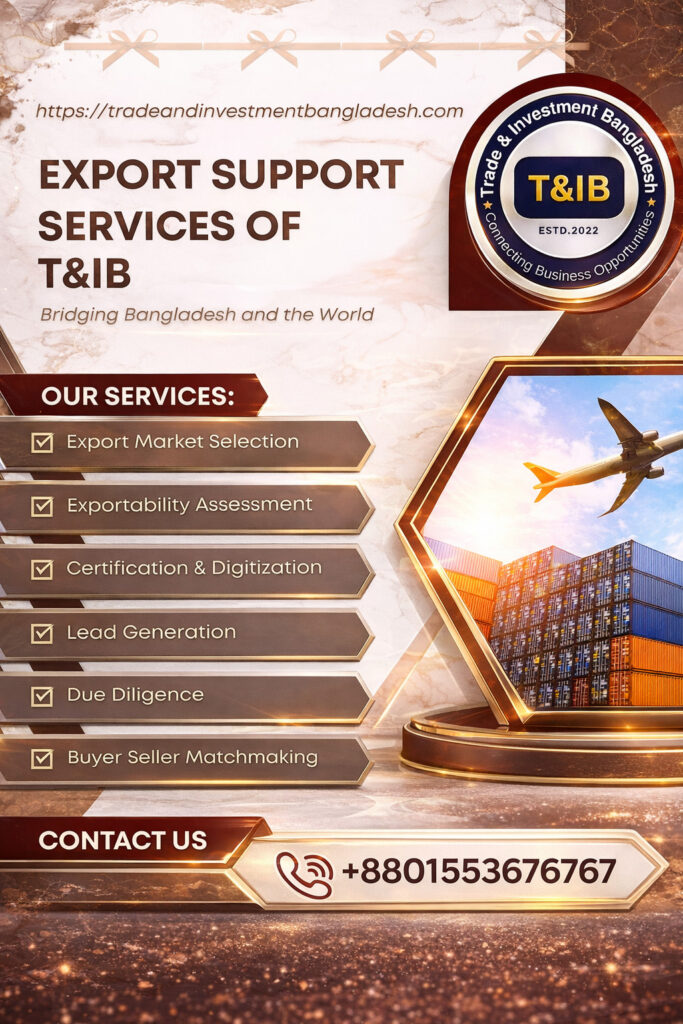
1. Export Readiness Assessment and Export Strategy Development
Export readiness assessment is one of the most essential export facilitation services. Many businesses want to export, but not all of them are practically prepared. A proper assessment evaluates whether a company has the product quality, capacity, management commitment, pricing ability, documentation knowledge, packaging standards, and operational discipline required for international trade. It also reviews whether the company has a realistic export vision and whether export activity can be sustained beyond a few trial shipments.
Once this assessment is completed, the business can develop a more structured export strategy. This strategy usually identifies suitable target markets, priority product lines, compliance needs, buyer segments, pricing considerations, and a phased action plan. The benefit of this service is that it saves time, reduces risk, and helps companies avoid premature market entry. Instead of operating on assumptions, the exporter moves forward with a practical, evidence-based roadmap.
2. International Market Research and Opportunity Mapping
International market research is critical for any exporter that wants to enter the right market with the right product. This service helps businesses understand where demand exists, which countries are importing similar products, what the market size looks like, who the key competitors are, what product specifications are preferred, and what barriers may affect entry.
In Bangladesh, this service is especially important because many exporters still rely too heavily on traditional markets while newer opportunities remain underexplored. A company may discover that its product has better potential in the Middle East, Africa, Latin America, East Asia, or niche European markets than in more saturated destinations. Market research also helps identify buyer types such as importers, wholesalers, retailers, sourcing agents, or industrial users. The key benefit is better targeting. Exporters can focus their resources where success is more likely, rather than wasting effort on unsuitable markets.
3. Product Adaptation, Packaging, and Compliance Support
A product that performs well in Bangladesh does not automatically qualify for export. Different countries have different technical requirements, labeling rules, safety standards, packaging expectations, and certification norms. This service helps exporters adjust their products and presentation to match destination-market requirements.
For some businesses, product adaptation may involve changing materials, sizes, ingredients, packaging language, barcode systems, shelf-life labeling, or environmental compliance. For others, it may require certification related to quality management, food safety, social compliance, or sustainability. This service is highly beneficial because it helps exporters avoid shipment rejection, customs delays, or buyer complaints. It also improves credibility and opens doors to more demanding but profitable markets.
4. Export Documentation and Trade Procedure Assistance
Documentation is one of the most sensitive areas in international trade. Even a small error in an invoice, packing list, shipping mark, certificate, or banking document can create delays, disputes, or payment problems. Export documentation support ensures that businesses understand what documents are required, how they should be prepared, and in what sequence they need to be submitted.
This service often includes guidance on commercial invoices, packing lists, certificates of origin, inspection documents, shipping instructions, insurance documentation, and letter of credit compliance. It may also include orientation on national export processes, registration, licensing, and communication with supporting institutions. The benefit is smoother export execution. Exporters become more accurate, more confident, and less vulnerable to avoidable procedural errors.
5. Buyer Identification and B2B Matchmaking
One of the biggest challenges facing Bangladeshi exporters is not production but market linkage. Many businesses can manufacture competitive products yet struggle to find reliable international buyers. Buyer identification and B2B matchmaking services are designed to solve this problem. They help exporters identify suitable importers, distributors, sourcing agents, retailers, or industrial buyers in selected markets.
These services may include lead generation, buyer screening, contact development, meeting arrangements, follow-up support, and even assistance in presenting the exporter’s company and products effectively. For foreign buyers, the service works in the opposite direction by helping them identify capable Bangladeshi suppliers. The benefit is more relevant business connections, better networking efficiency, and stronger chances of converting introductions into long-term trade relationships.
6. Export Pricing, Costing, and Commercial Offer Preparation
Many exporters lose business not because of product weakness but because of poor export pricing and weak offer preparation. Export costing is more complex than local pricing. It must account for production costs, export packaging, inland transportation, port handling, documentation costs, freight, insurance, commissions, and profit margin. If pricing is too high, the company becomes uncompetitive. If it is too low, the exporter may secure an order but lose money.
This service helps businesses calculate export prices accurately and prepare professional commercial offers such as quotations, pro forma invoices, product sheets, catalogs, and proposal documents. The benefit is both strategic and practical. Exporters become more competitive, more financially disciplined, and more professional in buyer communication.
7. Logistics, Freight, and Customs Coordination
Logistics is central to export performance. A good product and a good buyer relationship can still be damaged by delayed shipment, high logistics costs, poor cargo handling, or lack of coordination between parties. Export facilitation services related to logistics help businesses choose the best transport mode, understand Incoterms, coordinate with freight forwarders, plan shipment schedules, manage consolidation, and navigate customs processes more smoothly.
In Bangladesh, where export timing and logistics efficiency can significantly affect competitiveness, this service is highly valuable. It helps exporters reduce confusion, avoid unnecessary costs, and manage buyer expectations more effectively. The benefit is stronger delivery performance, lower risk of shipment disruption, and better control over the export supply chain.
8. Trade Finance and Payment Risk Advisory
Receiving payment securely is one of the most important parts of export business. New exporters are often unfamiliar with international payment methods and may accept risky terms without understanding the consequences. Trade finance advisory services help businesses understand letters of credit, advance payment, documentary collection, open account, and other payment methods. They also provide guidance on bank documentation, export proceeds realization, and transaction risk.
For many SMEs, this service is crucial because a payment problem can damage business confidence and financial stability. By understanding how to structure safer transactions, exporters can negotiate better terms and reduce the chance of fraud or non-payment. The benefit is stronger financial security, better cash flow management, and greater confidence in handling international trade deals.
9. Export Marketing, Branding, and Digital Promotion
The international market does not only reward production capability. It also rewards visibility, credibility, and presentation. Export marketing and digital promotion services help businesses present themselves professionally to foreign buyers through company profiles, brochures, websites, product catalogs, digital listings, SEO content, email campaigns, and social media positioning.
This is especially important for Bangladeshi SMEs that may have strong manufacturing capability but limited experience in international marketing. In many cases, foreign buyers first assess a supplier online before making any contact. A professionally presented business is more likely to receive serious inquiries and build trust quickly. The benefit is increased visibility, stronger brand identity, improved first impressions, and better lead generation.
10. Trade Fair Participation, Business Missions, and Export Aftercare
Trade fairs, expos, and business missions remain powerful tools for export promotion. They allow exporters to meet buyers, observe competitors, understand market trends, and showcase products in person. However, participation is only effective when it is well prepared. Export facilitation services in this area help companies choose the right events, prepare marketing materials, schedule meetings, organize presentations, and follow up with leads afterward.
Export aftercare is equally important. Many business opportunities are lost because companies fail to follow up properly after events or missions. Professional support helps convert meetings into negotiations and negotiations into orders. The benefit is better return on promotional investment, stronger relationship-building, and higher chances of real export conversion.
Export Support Services of T&IB
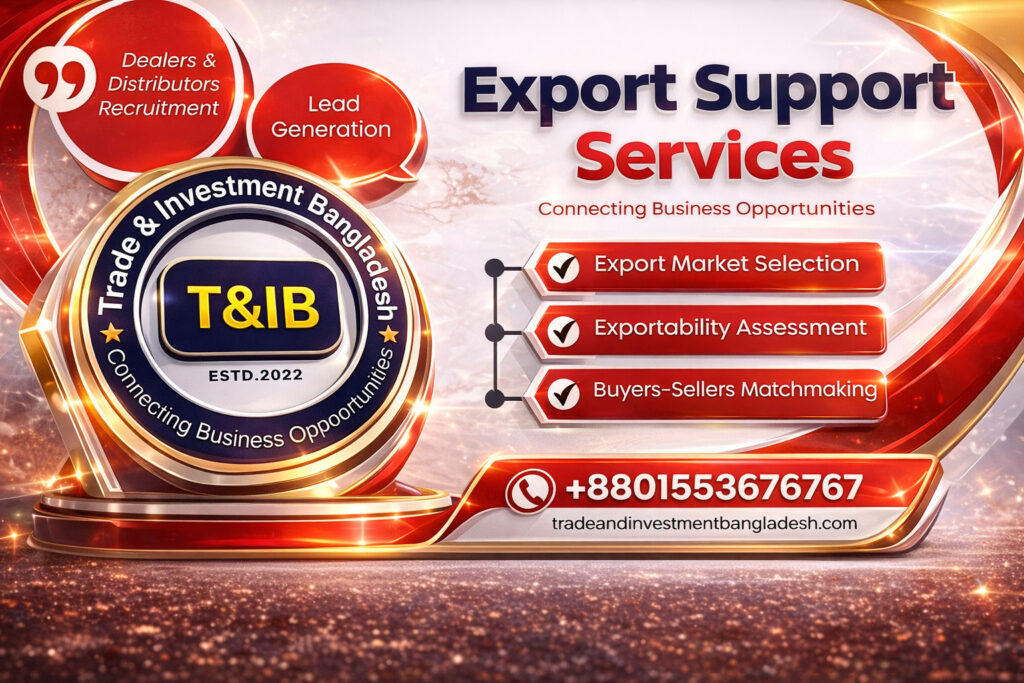
1. Export Readiness Consultation by T&IB
Trade & Investment Bangladesh (T&IB) can help local manufacturers, SMEs, entrepreneurs, and service providers evaluate whether they are genuinely ready for export. This service can include reviewing business capacity, product suitability, quality consistency, pricing ability, packaging readiness, export documentation awareness, and management commitment. For many businesses, this first-stage consultation is extremely valuable because it identifies strengths, weaknesses, and immediate action points.
The benefit of T&IB’s export readiness consultation is that businesses can start their export journey with greater clarity. Instead of moving ahead blindly, they understand what improvements are needed and what opportunities are most realistic.
2. International Market Research and Market Entry Guidance
T&IB can support exporters through structured market research and market entry planning. This may include identifying target countries, assessing demand patterns, reviewing competitor presence, understanding tariff and non-tariff barriers, and evaluating distribution possibilities. For a company planning to export from Bangladesh, this type of research can help determine where to begin and how to position its product.
The benefit is sharper decision-making. Businesses do not need to rely solely on hearsay or fragmented information. They gain a more evidence-based view of market opportunities and can choose export destinations more strategically.
3. Buyer Search and Business Matchmaking
T&IB can play a strong role in connecting Bangladeshi exporters with foreign buyers, importers, distributors, sourcing companies, and business associations. Its matchmaking support may include identifying prospective counterparts, facilitating introductions, arranging meetings, and supporting communication between parties.
The benefit of this service is that it reduces the time and uncertainty involved in searching for buyers. Rather than depending on random online outreach, the exporter receives more targeted business connection support, which improves the quality of engagement and the possibility of real commercial outcomes.
4. Export Documentation and Process Orientation
For new and developing exporters, export procedures often seem complicated. T&IB can provide guidance on documentation requirements, export workflow, transaction sequence, and coordination with relevant service providers. This may involve assistance related to invoices, packing lists, certificates, shipping documents, and procedural understanding.
The benefit is greater operational confidence. Businesses become better prepared to manage orders, reduce documentary mistakes, and interact more effectively with banks, logistics providers, and other trade-related institutions.
5. Company Profile, Brochure, and Export Presentation Development
T&IB can help exporters prepare professionally written company profiles, export brochures, digital catalogs, business presentations, and other promotional materials designed for international buyers. This is especially useful for SMEs whose products may be strong but whose communication materials are weak or outdated.
The benefit is improved credibility. Buyers tend to respond more positively to businesses that present themselves clearly, professionally, and consistently. Better marketing materials also strengthen the exporter’s brand image and support B2B communication.
6. Digital Marketing and Online Visibility Support
T&IB can support exporters through digital marketing services such as website development, website content improvement, SEO writing, social media visibility, directory listing, and online promotional campaigns. Since buyers increasingly search for suppliers online, these services help exporters become easier to discover and evaluate.
The benefit is broader global visibility and more consistent lead generation. For businesses that cannot immediately invest heavily in overseas travel or exhibitions, digital promotion provides a scalable way to build export presence.
7. Trade Mission and B2B Event Facilitation
T&IB can also support participation in trade missions, expos, buyer-seller meetings, and international networking events. Its services may include agenda preparation, communication support, meeting coordination, promotional material readiness, and follow-up planning.
The benefit is better event productivity. Exporters attend meetings with clearer objectives, stronger preparation, and better post-event conversion support, which improves the return on time and financial investment.
8. Sector-Specific Export Advisory
Different sectors require different export approaches. T&IB can provide sector-oriented export guidance based on the nature of the product or service. For example, apparel, agro-products, light engineering goods, IT-enabled services, leather items, or packaging products all face different market realities and compliance issues.
The benefit is more relevant and practical advice. Instead of receiving generic export suggestions, businesses get support that better matches their actual product category and market conditions.
9. Capacity Building, Training, and Export Orientation
T&IB can contribute to export ecosystem development by organizing export training, workshops, awareness sessions, and practical orientation programs. These may cover export documentation, market research tools, digital export promotion, trade communication, compliance issues, and buyer engagement.
The benefit is long-term capability building. Businesses gradually develop internal trade competence and reduce dependence on trial-and-error learning.
10. Long-Term Export Development Support
Perhaps one of the greatest strengths of T&IB is its ability to serve as a longer-term export support partner. Export development is rarely completed through one service alone. Businesses often need continuous support as they move from readiness assessment to market research, then to buyer search, then to promotional support, and later to market diversification.
The benefit of this long-term approach is continuity. Exporters can build sustained momentum instead of treating export support as a one-time transaction.
Why Local and Foreign Businesses Need Export Facilitation Services in Bangladesh?
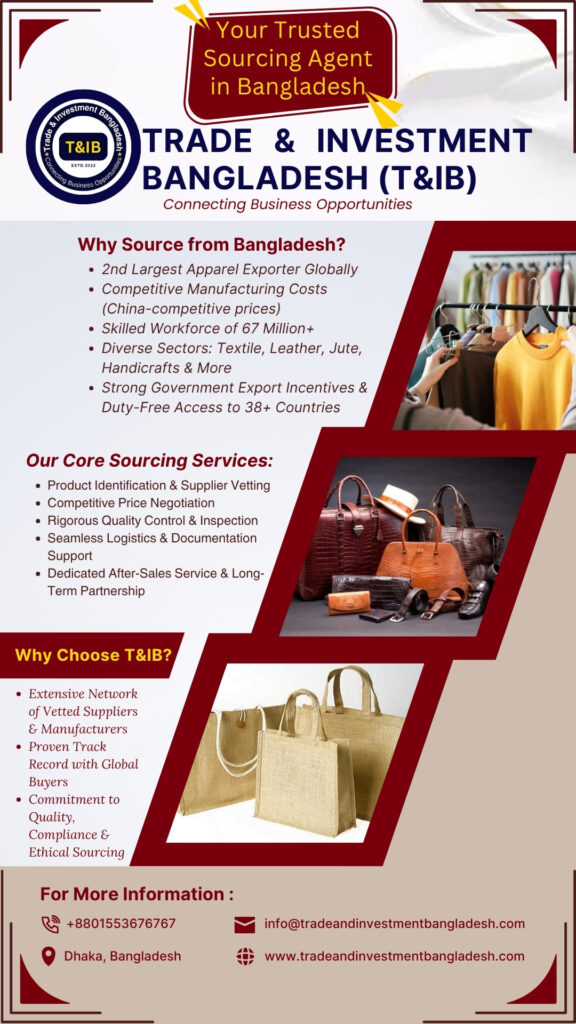
For local exporters, export facilitation services reduce complexity and accelerate progress. They help transform production-based businesses into internationally competitive suppliers. For first-time exporters, these services make the export process understandable and manageable. For growing exporters, they support expansion, compliance, and stronger buyer relationships.
For foreign businesses, export facilitation services make Bangladesh easier to access. Whether the company is looking for manufacturers, sourcing partners, or trade development opportunities, facilitation services help reduce market-entry barriers, improve supplier identification, and support smoother commercial engagement.
In both cases, the main value is trust, structure, and efficiency.
Closing Remarks
Export facilitation services in Bangladesh are becoming increasingly important as more businesses seek to participate in international trade. In today’s competitive global environment, export success depends on more than production capability alone. It requires strategy, compliance, communication, buyer access, logistics understanding, financial discipline, and sustained market development.
Bangladesh has strong export potential across a growing range of sectors. Yet many businesses still need professional support to convert that potential into real and sustainable export performance. Export facilitation services fill this gap by helping companies move from ambition to action, from local presence to global reach, and from isolated transactions to long-term international business growth.
For local entrepreneurs, manufacturers, and would-be exporters, these services provide a structured path toward export readiness and market entry. For foreign importers and trade partners, they provide a practical way to navigate Bangladesh and build reliable sourcing relationships. For institutions like T&IB, they create an opportunity to support trade development in a meaningful, integrated, and business-focused way.
As Bangladesh continues to strengthen its position in global commerce, the importance of export facilitation services will only grow. Businesses that invest in these services will be better prepared to manage risk, meet buyer expectations, compete effectively, and achieve long-term success in international markets.
